72 hr
3-Day Chitwan Jungle Safari from Kathmandu or Pokhara
All-inclusive 3-day escape to Chitwan National Park with jeep safari, canoe ride, and Tharu culture.
Reserve
Hand-picked by our editors — only the best 5 multi-day safari packages from 60 reviewed.
Verified partners for every tour, free cancellation where available, and instant confirmation on every booking.
72 hr
All-inclusive 3-day escape to Chitwan National Park with jeep safari, canoe ride, and Tharu culture.
Reserve
72 hr
3 days of jeep safaris, canoe rides & Tharu culture in Nepal's wild Chitwan National Park.
Reserve
72 hr
3 days of jeep safaris, canoe rides, and jungle walks in Nepal's wildlife-rich Chitwan National Park.
ReservePrices from verified partners. Availability updates in real time at checkout. Free cancellation policies apply where shown.
The landmarks, rooms, and views travelers on this tour remember — all visible on a single visit.
Kasara is the administrative heart of Chitwan National Park and the most practical starting point for a Chitwan jungle safari package. It sits inside the park’s core access area, and the headquarters location also makes it the usual place for permits and official coordination.
The gharial facility is one of the park’s key conservation sites and helps explain why Chitwan is known for river wildlife as well as forest animals. Chitwan National Park is Nepal’s first national park, established in 1973, and the breeding work reflects its long protection history.
The river corridor is important for crocodiles, birds, and lowland habitat changes that are very different from the forest interior. In a Chitwan jungle safari package, this is the kind of edge habitat where guides often look for marsh and river species.
Sal forest is a defining forest type in the park and is where many safari drives feel most enclosed and quiet. Chitwan’s protected area covers 952.63 square kilometers, so these tracks are part of a very large habitat system.
The Reu River is a notable water boundary within the park landscape and is referenced in park management discussions. For visitors, it adds another riverine habitat layer to a Chitwan jungle safari package and helps explain the park’s mixed forest-river ecology.
The buffer zone around the park shows how conservation and local life meet at the edge of the protected area. Chitwan’s buffer-zone system is part of what makes the park’s tourism and wildlife management more complex than a simple one-track visit.
They complement each other, but the chitwan jungle safari package is the easier, fuller-activity choice, while Bardia is the more remote, lower-traffic safari experience. If you want simpler access and a broader day-plan, choose Chitwan; if you want a quieter, wilder feel, choose Bardia.
| Feature | Top pick Chitwan National Park | Bardia National Park |
|---|---|---|
Access from Kathmandu/Pokhara |
Kasara; road-based from Kathmandu | Nepalgunj via air or road |
Safari style |
Jeep, canoe, jungle walk, culture | Jeep, jungle walk, boat ride |
Crowds |
Busier, more visited | Quieter, lower traffic |
Wildlife viewing feel |
Mixed activities, classic Terai safari | Remote, more secluded sightings |
Trip length fit |
Works for shorter itineraries | Better for longer, slower trips |
Best for |
First-time Nepal wildlife trips | Low-crowd safari seekers |
| See tickets → |
Verdict: For most travelers, Chitwan is the easier all-round pick, while Bardia suits visitors who want a quieter safari and do not mind the extra travel to reach it.
Choose your ticket, select your date, and reserve in under two minutes. Secure checkout handled by our verified partner.
Instant confirmation by email, with a mobile voucher you can save offline. No printing, no queuing at a collection desk.
Arrive at the entrance, show your voucher on your phone, and walk in. Most tickets include priority or skip-the-line access.
Practical details for your visit straight from our verified partners — hours, access, rules, and how to get there.
Wear lightweight, breathable clothing in muted colors that blends into forest surroundings. Closed-toe shoes are better than sandals for dusty roads, grass, and uneven terrain around Kasara and the safari routes.
Carry a small daypack only, since safari vehicles and park checkpoints are not suited to bulky luggage. Keep passports or permit copies accessible for entry checks at the gate.
Bring a zoom lens or binoculars if you want usable wildlife shots from a moving jeep. Avoid flash photography near animals and never ask a driver to leave the marked route for a better frame.
Access is easiest by vehicle to Kasara, where the park headquarters is located. The safari experience is terrain-based and can be bumpy, so travelers with mobility concerns should expect limited onboard comfort and uneven ground at stops.
Families can do a Chitwan jungle safari package, but children should stay seated in vehicles and follow guide instructions closely. The park environment is hot in the day and activity is best early, so a morning departure is usually the least tiring option.
Eat before departure or bring simple snacks, because food service inside the safari area is limited. Carry water in a reusable bottle and keep all wrappers sealed so nothing is dropped in the park.
The Chitwan jungle safari package route commonly centers on Kasara and nearby jungle-drive corridors, so plan for dust, heat, and early starts. Rangers and guides focus on wildlife safety first, especially around rhino, elephant, and crocodile habitat.
Best time to go, insider tips, nearby landmarks, and the cancellation fine print — flip through to skim what matters to you.
Flexible, no hidden fees.
Because this is a live tour-grid page, cancellation terms should follow the booked safari product shown alongside the content. Any park-entry component should use the published foreign adult fee of 2,000 NPR per entry when applicable.
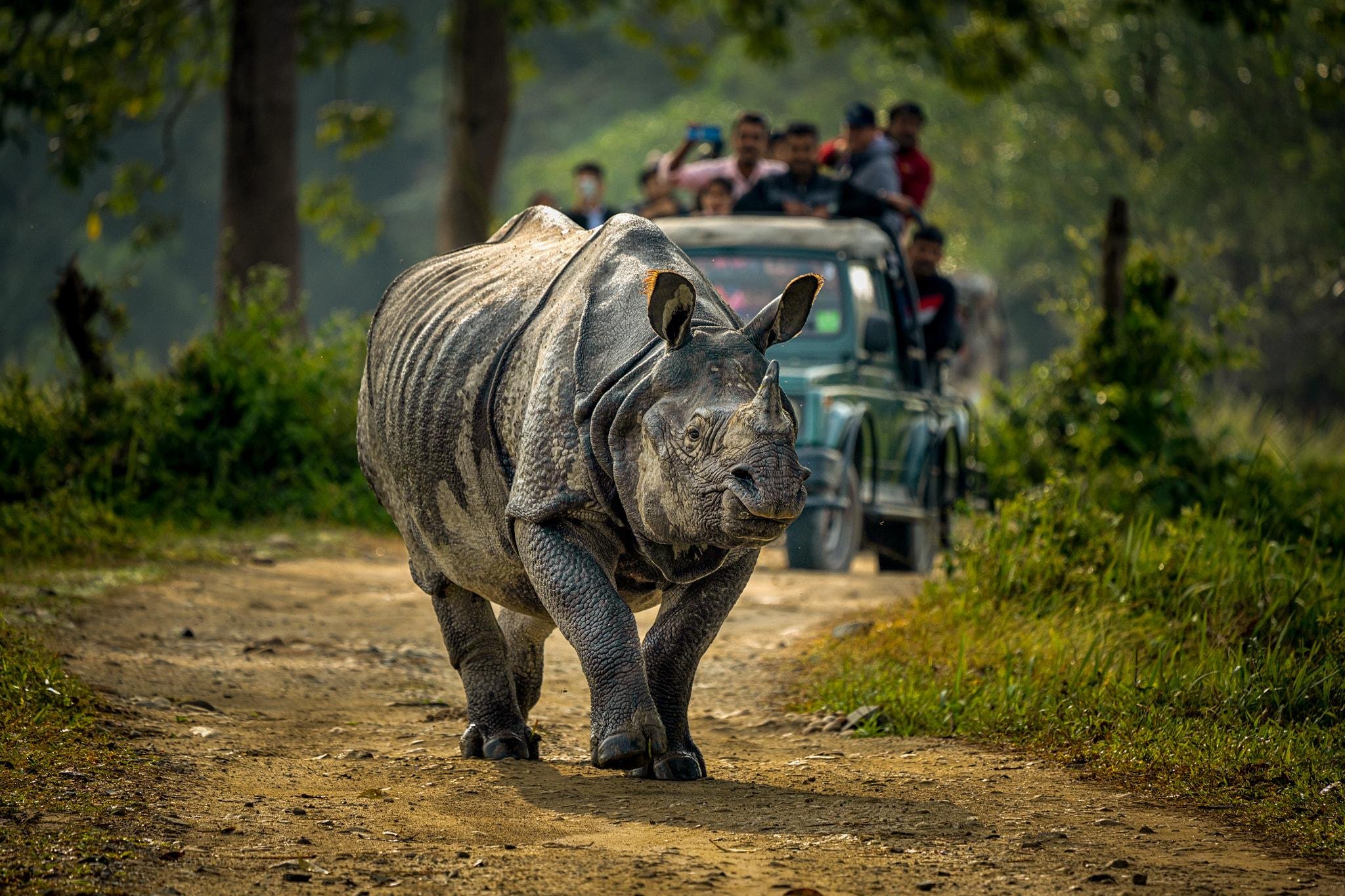
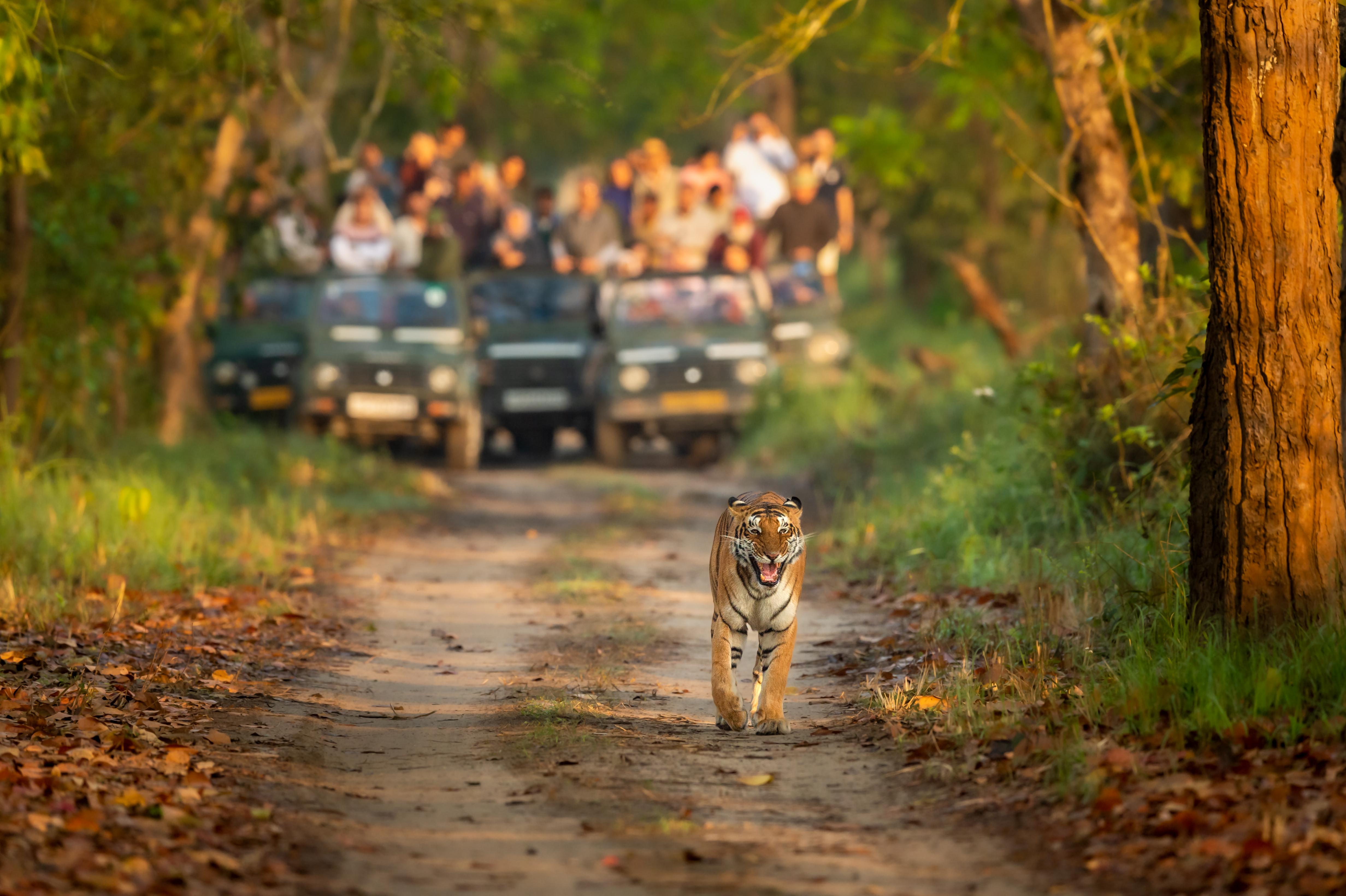
Chitwan was a royal hunting reserve before it was a sanctuary, and in a single 1938 shoot a viceregal party is recorded as taking more than a hundred tigers and rhinoceros from these grasslands. The reversal took three decades. Nepal gazetted the area as the country's first national park in 1973, drew a boundary of 952 square kilometres across the Terai lowlands, and posted an army battalion inside it. UNESCO inscribed the park as a World Heritage Site in 1984. The recovery is measurable. Greater one-horned rhinoceros numbers, driven near collapse by poaching, climbed back into the six hundreds across Nepal, with the majority grazing the alluvial floodplain here. Bengal tigers move through the same sal forest, mostly unseen. What a chitwan jungle safari package sells, honestly stated, is probability rather than promise — of gaur, sloth bear, gharial crocodile on a sandbank, and some five hundred and forty recorded bird species overhead. Geography explains the density. The Rapti, Reu and Narayani rivers braid through the park's northern and western edges, laying down silt that feeds tall elephant grass, some of it four metres high by late summer. Behind the grassland stands sal forest, covering roughly seventy per cent of the park. Between them sit oxbow lakes and riverine strips where sightings concentrate. Park headquarters and the Gharial Breeding Centre lie at Kasara, near the centre of the reserve. The human history is not incidental. Tharu communities have farmed and fished this valley for centuries, carrying an inherited resistance to the malaria that kept outsiders away until eradication programmes opened the Terai in the 1950s. Their stick dances, longhouses and fish traps remain part of the buffer-zone landscape that chitwan jungle safari package tours cross on the way in. Half of the park's tourism revenue is returned to those buffer-zone communities by law, which is why conservation here is discussed in terms of livelihoods as much as wildlife. That model is now studied elsewhere. Nepal recorded multiple years of zero rhino poaching in the decade after 2011, a result attributed to combined army patrols, community informants and the buffer-zone revenue share. Chitwan National Park sits at the centre of that record. The park operates daily from 06:00 to 18:00, and entry for a foreign adult costs 2,000 NPR. Multi-day chitwan jungle safari package tickets bundle that access with lodging in Sauraha or Kasara and guided time inside the boundary, which remains the only way most visitors will see the floodplain at all.
"What the park sells, honestly stated, is probability rather than promise."
A step-by-step walkthrough of the visit — what you'll see, how long each stage takes, and the details that matter.
You leave Kathmandu or Pokhara in the morning and reach the Terai by mid-afternoon, roughly five to six hours by road on most three-day itineraries. You check into a lodge in Sauraha, drop your bag, and walk to the Rapti riverbank before the light goes. Day two starts early. You aim for the 06:00–08:00 arrival window, when temperatures are cooler and wildlife activity is at its highest, and pay the 2,000 NPR foreign adult entry at the gate. You board a dugout canoe carved from a single kapok trunk and drift downriver, low to the water, close enough to count the gharials on the sandbanks. You step off, and a naturalist leads you into the sal forest on foot, single file, reading pug marks and rhino dung. In the afternoon you climb into an open jeep and cross the grassland toward Kasara, stopping at the Gharial Breeding Centre. Your chitwan jungle safari package includes the guide, the permits and the transfers. Evening brings a Tharu stick dance at the cultural centre. Day three, you take a final river walk, then reboard for the drive back. On the private and luxury versions of the safari, the vehicle and the itinerary are yours alone.
The park is open daily from 06:00 to 18:00, so a Chitwan jungle safari package can be planned for any weekday or weekend. The best arrival window is 06:00–08:00, when temperatures are cooler and wildlife activity is better.
The published foreign adult entrance fee is 2,000 NPR per entry. If your Chitwan jungle safari package includes park entry, that fee is the conservation charge to expect for an adult foreign visitor.
Aim to reach Kasara between 06:00 and 08:00, which is the recommended arrival window. That timing gives you the best chance of seeing animals before the day heats up.
Yes, a Chitwan jungle safari package can work for families if children can stay seated and follow the guide’s safety instructions. Early morning is usually the easiest time for younger travelers because it is cooler and less tiring.
Wear lightweight, muted clothing and closed-toe shoes. A Chitwan jungle safari package is best done in practical layers because the vehicle ride can be dusty and the jungle edge terrain is uneven.
Keep your bag small and avoid bringing bulky luggage, since the safari vehicle and entry checks are set up for day visitors. Do not carry prohibited items such as drones, firearms, alcohol, open flames, or single-use plastic bags.
Yes, photography is allowed, and a zoom lens is very useful from a moving vehicle. Flash should be avoided around animals, and you should stay on the designated route during the safari.
Bring water and simple snacks, but do not rely on food service inside the safari area. Keep all waste sealed and carry it back out so nothing is left behind in the park.
Use the Kasara address in Chitwan National Park, Chitwan, Nepal, as the destination for your Chitwan jungle safari package. Bharatpur is the nearest major city, and Sauraha is a common tourist base for park access.
Refund terms depend on the booked tour product shown in the live inventory on this page, so the specific policy can vary by package. Park-entry charges, when charged separately, should be calculated from the published 2,000 NPR foreign adult fee.
You can combine the safari with stops in Sauraha, Ratnanagar, and Bharatpur. Those nearby towns are the main bases for lodges, guides, and other park-related activities.